
What Does RSVP Stand For? Meaning, Origin & Usage
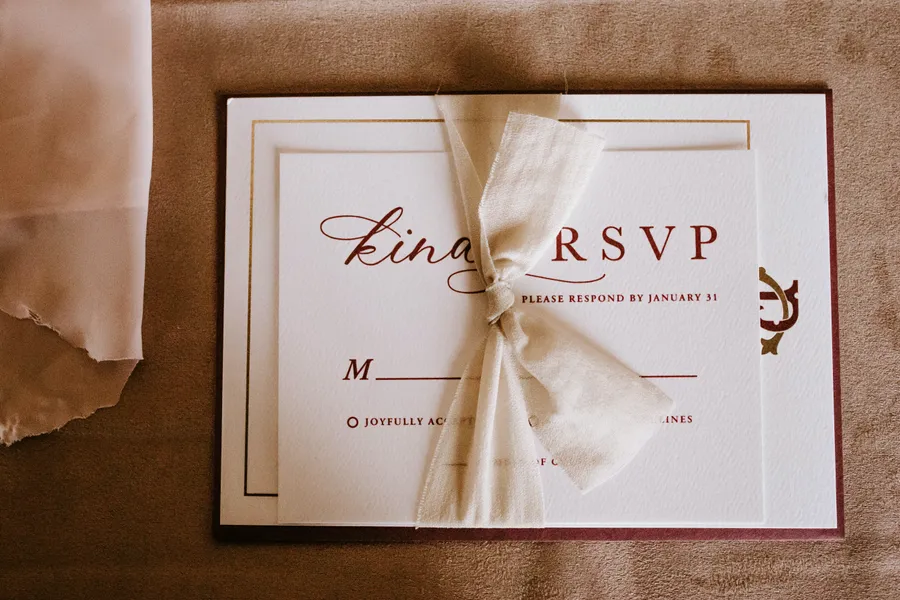
Four letters, one polite request, three centuries of history. RSVP is one of those rare invitation conventions that has survived emails, group chats, and event apps — and still shows up on wedding stationery and birthday cards in every English-speaking country. Here’s what it stands for, where it comes from, and how to handle it without thinking twice.
What does RSVP stand for?
RSVP stands for “Répondez s’il vous plaît” — a French phrase that translates to “please respond.” When you see RSVP on an invitation, the host is asking you to confirm whether you’ll attend.
The acronym itself is the four initials of the French words, used as a single recognizable mark. Hosts write it on the invitation, guests reply by the requested deadline, and the host can then plan headcount, seating, catering, and logistics accordingly.
What does RSVP mean in English?
In English, RSVP literally translates to “please respond.” It is not an English acronym — there is no equivalent English phrase that the letters R-S-V-P stand for. The borrowing kept the French letters intact because by the time invitations began carrying the request, French was the language of formal etiquette in Europe and North America.
Functionally, RSVP signals two things to the invited guest:
- A response is expected. Not optional — the host is planning around your answer.
- A deadline applies. Even if the invitation doesn’t state one explicitly, replying within a week of receiving the invitation is the cultural baseline.
Why do Americans say RSVP?
The phrase entered American English in the 19th century, when French was the language of high society and formal etiquette across Europe and the United States. Wealthy American families adopted French invitation conventions wholesale — engraved cards, formal wording, and the RSVP request — and the convention spread from there into broader middle-class use.
It stuck for three reasons:
- Brevity. Four letters do the work of a full sentence.
- Universality. RSVP is recognized internationally — guests from other cultures parse it instantly.
- Politeness. The implied “please” makes the request feel courteous rather than demanding.
Today the convention is fully naturalized in American English, used on everything from black-tie weddings to casual birthday party invites and corporate events.
What does RSVP mean on an invitation?
On an invitation, RSVP is the host’s request that the guest reply whether they will attend. Hosts need this confirmation to plan:
- Seating — table arrangements, place cards, room layout.
- Catering — meal counts, dietary preferences, beverage quantities.
- Logistics — venue capacity, parking, transportation, gift bags.
A typical RSVP line on an invitation looks like:
RSVP by April 12 to Sarah at sarah@example.com
That single line tells the guest: a response is expected, here’s the deadline, and here’s how to deliver it. Modern digital invitations replace the email or phone with a clickable link, but the underlying request is identical.
If you receive an invitation without an RSVP line, attendance is usually optional — a “drop in if you can” event. If RSVP is on the invitation, the host is counting on your answer.
How do I respond to an RSVP?
Respond promptly — ideally within a week of receiving the invitation, and always before the deadline stated on the card. The exact channel depends on what the host requested:
- Mailed reply card with prepaid postage — fill in your name, check Yes or No, mail it back.
- Phone or text — short and direct, especially for casual events.
- Email — typical for corporate events and modern weddings.
- Digital RSVP link — click, pick Yes or No, optionally add headcount and dietary notes.
A few etiquette pointers:
- Reply even if you can’t attend. A “no” is more useful than silence — hosts can adjust seating, catering, and gift logistics.
- Stick to your answer. Don’t RSVP yes and then disappear; don’t RSVP no and then show up. Both create real problems for the host.
- Bring up changes early. If your plans shift after RSVPing, tell the host as soon as possible.
- Don’t expand the invitation. If the invitation is addressed to you, don’t assume you can bring a plus-one or your children unless the invitation explicitly says so.
What’s the easiest way to collect RSVPs online?
For modern events, the easiest way to collect RSVPs is a free online RSVP tool like Whocan. The flow takes about three minutes:
- Create the invitation page — title, date, location, optional dietary fields and deadline.
- Pick a theme — wedding, birthday, holiday, casual, baby shower.
- Share the link via WhatsApp, email, or any messenger.
- Track responses in real time — yes / no counts, names, headcounts, dietary notes, all in one dashboard.
The advantage over email or paper cards is the dashboard view: instead of counting replies in your inbox, the tool aggregates everything in one place, lets you edit responses, and exports to Excel for the venue or caterer. With Whocan specifically, neither you nor your guests need to create an account — the tool is free across all features, ad-free on the invitation pages, and available in six languages.
For very small or very formal events, traditional channels (phone, mailed card) are still fine. For everything in between — group dinners, birthday parties, baby showers, casual weddings, team events — a digital RSVP link is faster and easier to track.
When did people start using RSVP?
The phrase “Répondez s’il vous plaît” was first popularized in 18th-century France, during the reign of Louis XIV and the rise of elaborate aristocratic entertaining. French nobles hosting balls and dinners needed a way to manage guest lists at scale — and a written request for confirmation became the convention.
The four-letter acronym followed naturally: shorter to engrave, more elegant on a card, and quickly recognized within the French-speaking aristocracy.
It crossed into English-speaking countries in waves:
- Late 18th century — adoption among British and American aristocrats imitating French court customs.
- 19th century — broader spread through middle-class formal etiquette books.
- 20th century — full naturalization into mainstream wedding, birthday, and corporate invitation conventions.
Today, RSVP is one of the oldest invitation conventions still in everyday use — three centuries old, four letters long, and as functional on a paper wedding card as on a WhatsApp link.
Planning an event? Create a free online invitation with RSVP in three minutes — no account, no ads, multilingual.